
Dayshift
Unwinding my fingers from the black telephone cord, I swivel in my chair and glance up at the clock, which confirms my shift ended ten minutes ago. I don’t have the heart to interrupt the caller, a young mom with two children who recently left her abusive husband and now faces the agony of sending her two young children to a father they are afraid of for court-ordered parenting time.
I swing back to the desk, doodling spirals on the notepad in front of me while listening to her justified fears and giving her advice on the few options available. Document everything. Take the kids for an assessment by a doctor or psychologist. Inform her lawyer. Everything but what I know is in her heart and mine. Take those kids and run! Ten minutes later, she sighs and thanks me. Tells me she has to go. Flipping open the call-log binder, I document the call. No name, but enough information that the rest of the staff will likely recognize her story if she calls again, so she won’t have to repeat everything. I put the files in the drawer. Stand. Stretch. Walk to the staffroom to go over the events of my shift with the oncoming staff. Gather my things and head out the door, past the pile of kids’ shoes scattered around but not quite on the mat.
With the first step out into the cool air, a deep sigh escapes me. Closing the door securely, I fumble for my keys. The reassuring, relaxing voice of Bob Marley comes on mid-song as I turn the key to start my car. I back out of the driveway and turn the corner. As the car pulls away from the shelter, a slight distance grows between me, my life, my own joys and sorrows and the laughter, tears, and pain of those who have no safe home to return to.
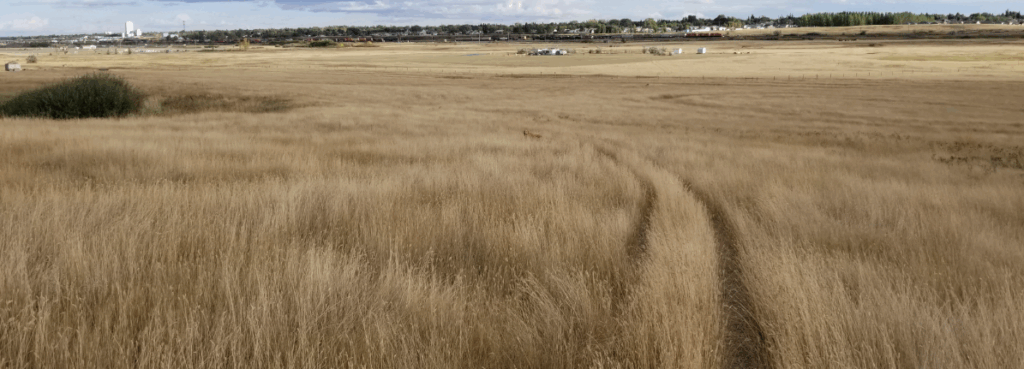
Cruising down 9th Avenue, over the bridge spanning the railyard, I look to my left at the rivulet of water edged by rushes that leads to open ground. A scrubby wasteland to most eyes, stretching north of the tracks, claimed only by the red-winged blackbirds so protective of their nests and tenanted in the summer months by the unassuming and unafraid meadowlark trilling from his perch on a weathered post. My forehead is hot. My skin is glazed with an oily sheen as if the stress of the day is leaking through my pores. Pulling up in front of my house, I take a grateful glance at the looming poplar tree which hides my house from view. The old porch floor creaks under my steps as I rattle my key clumsily in the lock and swing the door wide. I am met by a sleepy, stretching dog whose tail begins to wag in anticipation. Dropping my work things, I grab the leash and lead the dog to the car. Back on 9th Avenue, but this time, I turn towards the open field. My dog bounds out of the back of the car; no leash is required here. All around me is the sky, a different image in each direction.
Music streams from my earphones. With slow steps and deep breaths, I begin to walk. A cold wind rushes over me, cools my forehead, and sweeps away my anxiety along with the sweat. Soothes me. Walking, breathing, watching my dog racing through the long, rust and amber-coloured swaying grass, I regain myself.
For two decades, I worked as a frontline emergency shelter worker at Moose Jaw Transition House. In that time, my worldview shifted. Though I grew up in a home impacted by intergenerational cycles of violence and had experienced violence and abuse in a short-lived relationship myself, I hadn’t realized the scope of the problem or the severity of violence that is rampant in our communities. My own experiences of abuse helped me to understand the women that came and went from the shelter, even those that came and went and came again. If all you have ever known is abuse or neglect as a child, if you have watched your parents play out a pattern of abuse with words or fists, you are already primed to accept or enact abuse. I could understand that.
The common misunderstanding by those who haven’t lived with this type of abuse, aptly termed intimate terrorism, is demonstrated by the question “Why doesn’t she just leave?”. The reality is that often it is easier, and sometimes even safer, to stay. It is easier because you don’t have to confront the reality of your situation. If you stay, you don’t have to admit to yourself or the person at the other end of the helpline that you are a victim. You don’t have to experience all the neighbours looking out their windows when the police car pulls up in front of your house. You don’t have to describe all the humiliations that you were subject to or justify your choice to flee to your family, friends, co-workers and neighbours. You don’t have to hear about the campaign of slander waged against you by your ex-partner telling anyone who’ll listen that you’re the abusive one, that you cheated, are crazy, are a bad mother, a homewrecker and that everything that’s gone wrong is all your fault.
It may be safer to stay in some cases as well. Intimidation and threats are part of the pattern of abuse and control meant to keep victims under the thumb of their abusers. “If you leave me I will…” becomes a mantra for the abuser. You can fill in the blanks any number of ways – “You’ll never see the kids again, I will tell everyone what a horrible person you are, I will destroy you, I will kill you, your family, your beloved pet”. In Canada, a woman is killed by a current or former intimate partner every 6 days on average. The two most common risk factors for domestic homicide are a prior history of domestic violence and current or pending separation. When we listen to stories of family members of those lost to domestic homicide, a common pattern is that, after living with the abuse for a long time, the victim had begun to regain their self-esteem. They may have gone back to school to improve themselves or started eating healthier and going to the gym. They may or may not have made a conscious choice to leave or informed their partner that they are leaving. In a review of domestic homicides spanning 15 years in Ontario, it was found that recent or pending separation was a factor in 67% of the cases.
The sentiment “If I can’t have you, no one can” underlines the sense of ownership some men continue to feel towards women and their children. The words “Till death do us part” shift from a hopeful and loving vow to a sinister threat.
Nightshift
It’s 11:05 pm. My alarm goes off. I crawl reluctantly out from beneath the warm covers, shivering at the touch of cold air on my skin. I flick on the light and dress quickly, pulling on loose comfortable clothes, a T-shirt, yoga pants, and a warm hoodie. I tiptoe from my room into the hall, conscious of my daughter sleeping in the room next to mine and my son in the room below hers. I don’t want to wake them.
Eyes burning in protest at this violation of my natural circadian rhythm, I gather the supplies that will help me get through the long night ahead. Carrot sticks, cheese and crackers and a bag of black licorice to help me to stay awake. I grab the book I’ve been reading and the canvas bag that contains a half-finished crochet blanket and yarn. Our Border Collie, Pippin, her black fur shining in the light, has been watching me prepare. Alert but also familiar with this routine, she lies quietly.
I pull on my winter coat and boots and step out into the cold winter night. The sky is black velvet spattered with stars. I breathe deeply, inhaling crisp air with a hint of woodsmoke tang. If getting out of bed is the hardest part of working the night shift, this is the best part. Silence is all around me. For a moment, I feel like I could be the only person awake in the whole world. Then I hear a car passing a few streets away, and the spell is broken. Glancing back at the house, I say a silent prayer that my kids, ages 16 and 12 and alone now in the house, will be safe in their beds while I am away watching over others at the local domestic violence shelter.
When darkness falls, and the house gets quiet, fears take hold. Nightmares and flashbacks. Women wake in a cold sweat or lay on an unfamiliar mattress, staring into the dark with eyes wide open. Awakened by the sound of another family arriving in the dead of night. Children, scared and sleepy, shushed by their moms on their way to their own unfamiliar room. Staff tiptoeing down the hall with sheets and quilts, pillows and pyjamas. In the dark of night, staff and residents stiffen at strange sounds, each woman telling herself, no, it can’t be, it won’t be him outside my window.
I stare up at the blurry screen showing the security feed, trying to distinguish between branches blowing in the wind and the shape of a dark figure in the yard. It happens sometimes. A disgruntled man thumping on the door demanding that we release his wife and children. A dark figure, hood up over his head slipping into the driveway to slash the tires of his ex-partner’s car. From midnight until two a.m., the women, unable to sleep due to pain from injuries, concern for sick children or anxiety about their future, may be awake and wanting to talk. They are looking for company and comfort to get them through the night. They sit in the staff office in their pyjamas and robes, cup of coffee or tea in hand, needing to be heard. My job is to listen. To reflect to them all that they have done to keep themselves safe and protect their children.
After 3 a.m., the chance of anyone calling or arriving at the door grows less. By 5 a.m., the real struggle to stay awake begins. Eyes burn, and stomach churns. Reading becomes impossible. Getting up. Sitting down again. Pacing. Reaching for snacks or crocheting all help get through the last dark hours. By 7 a.m., the residents are stirring. Moms are getting their kids ready for school or themselves ready for work. With the sun come more practical concerns, the need to find a safe and affordable place to live, apply for social assistance or find a lawyer. The hands on the clock click forward slowly during this last hour before the day staff come on at 8 a.m. Relief floods through me when I can turn over the responsibility for the shelter and all those in it to someone else. Sometimes, as I approach my house, the short drive home has already become a blur. I wonder if I stopped at the lights on 9th Avenue.
I arrive home shortly after 8 a.m.; my kids are just waking up and have slept safely through the night. I give silent thanks and join them at the breakfast table, where we chat over bowls of Cheerios. By 8:45, they are on their way to school. Exhausted now, eyes burning, I head upstairs and try to sleep as long as I can. I will grab a few hours now and get up in time to walk the dog, make supper and spend some time with the kids. If all goes well, I’ll head back to bed for an hour or two before my shift.
It’s 11:05 pm. My alarm goes off.